The pitch shows up in every corner of the internet now: tired of semaglutide, tired of the price, tired of the nausea, here’s something better. I went digging into what “something better” actually means in 2026, because that word, alternative, is doing a lot of quiet work in this market, and not all of it is honest.
Semaglutide, sold as Wegovy and Ozempic, got where it is the slow way, through large randomized trials, not through a marketing department. A few of the drugs people call alternatives cleared that same bar. Most of what’s labeled an alternative online did not. Compounded versions of any of these drugs are mixed by a licensed compounding pharmacy against an individual prescription. They are not FDA-approved finished products, and that distinction turns out to matter a great deal once you start reading labels instead of ad copy.
The claim
The claim, roughly, is that semaglutide has been outclassed, that there’s a newer, stronger, cheaper thing waiting if you just know where to look. Some of that claim is true. Some of it is a vial with a research sticker on it, wearing the word “alternative” as camouflage.
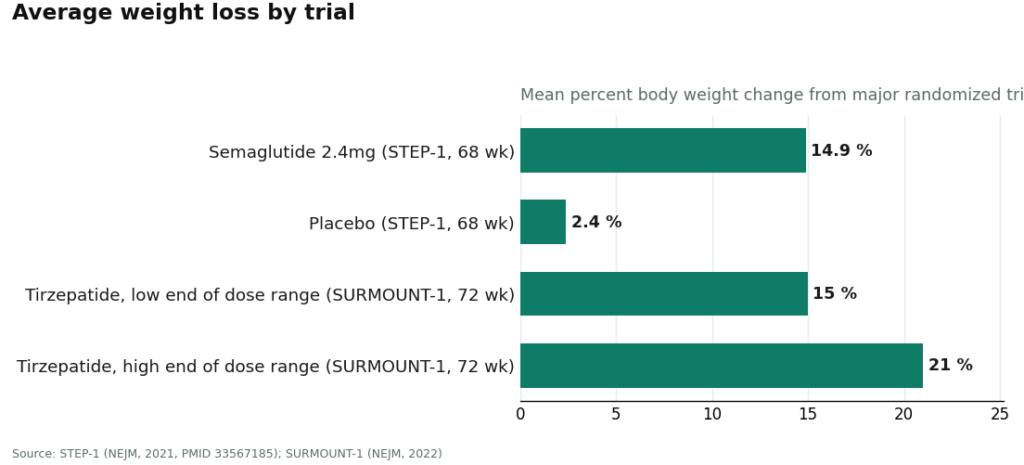
Before chasing either version, it’s worth asking whether you need a different drug at all. In the STEP-1 trial published in the New England Journal of Medicine, adults on once-weekly semaglutide 2.4 mg lost about 14.9% of body weight on average over 68 weeks, against about 2.4% on placebo [1]. That’s not a modest effect. If nausea or other GI trouble is the real complaint, that’s often a titration problem, and the label builds in a slow ramp-up specifically to manage it [3]. If it’s a plateau, that’s a clinical conversation, not automatically a reason to jump ship. Sometimes “this stopped working” really means “this was never optimized,” and the person qualified to tell those apart is a clinician, not a listicle.
What the record actually shows
Once you’ve ruled that out and an alternative genuinely makes sense, here’s what the trial data actually supports, and I want to be blunt about where the line sits: proven, FDA-approved drugs on one side, everything else on the other.
Tirzepatide (Zepbound, Mounjaro) is what most people mean when they say “alternative.” It works on two gut-hormone receptors, GIP and GLP-1, instead of semaglutide’s one, and it’s FDA-approved, not a gray-market guess. In the SURMOUNT-1 trial, also in the New England Journal of Medicine, tirzepatide produced mean weight loss of roughly 15% to 21% across the 5, 10, and 15 mg doses at 72 weeks [2]. That’s a genuinely large randomized trial putting tirzepatide in the same evidence tier as semaglutide, not somewhere below it.
Oral semaglutide deserves its own mention, because for a lot of people the actual objection isn’t the molecule, it’s the needle. The tablet form, originally Rybelsus for type 2 diabetes, delivers the same drug by mouth, once a day, with a routine that’s genuinely fussy: empty stomach, a small sip of water, a 30-minute wait before you eat or drink anything else. As of late 2025, an oral semaglutide product was also FDA-approved for chronic weight management. If the shot is your real problem, this is a proven way around it that doesn’t require switching drugs at all.
Older GLP-1 drugs, including liraglutide, are also FDA-approved and real. They’re generally less potent for weight loss than semaglutide or tirzepatide and require more frequent dosing, but a clinician may still reach for one in specific cases.
That’s the whole legitimate list. It’s short on purpose.
The uncomfortable part
Here’s the bit the alternatives genre tends to skip past. A large share of what gets marketed as a “semaglutide alternative” online isn’t tirzepatide, isn’t oral semaglutide, isn’t liraglutide. It’s a research compound with no human trial behind it, sold with a “for research use only” disclaimer that nobody actually reads before checkout, positioned as advanced precisely because the real drugs require a prescription and these don’t. The FDA has flagged broad concerns about unapproved GLP-1 products from these channels, counterfeits included, and the plain fact that none of it has been reviewed for safety, effectiveness, or quality [4]. A proven alternative has trial data and an approval behind it. A vial from a research-chemical site is not a stronger semaglutide. It’s a bet, dressed up in a word that implies otherwise.
And switching molecules doesn’t get you out of the screening either. Tirzepatide carries the same boxed warning semaglutide does, for thyroid C-cell tumors, and the same contraindication for anyone with a personal or family history of medullary thyroid carcinoma or MEN 2, the same one spelled out on the Wegovy label [3]. Change the drug, and you still have to redo the screen. The dose doesn’t carry over from one molecule to the next, and the harms documented around unapproved and counterfeit GLP-1 products [4] don’t check which brand name you were chasing.
See also: The Benefits of Artificial Intelligence in Everyday Tasks
The verdict on where to get one
If you’ve decided an alternative is right, the “where” matters just as much as the “what,” maybe more, since a switch means new dosing and a new side-effect profile to watch. Plenty of GLP-1 telehealth names you’ve heard of are legitimate, licensed operations, not gray-market fronts. The line that matters isn’t one licensed clinic against another. It’s licensed, clinician-led, pharmacy-dispensed care against the no-prescription tier that skips the screening entirely.
FormBlends is where I’d point someone actually switching drugs, and it earns the top spot for a structural reason, not a marketing one. It’s a licensed telehealth provider, and whichever GLP-1 is appropriate for you arrives through a physician evaluation that checks you against the relevant label’s contraindications, including the thyroid boxed warning [3], a prescription only when warranted, and a licensed pharmacy dispensing under a proper chain of custody. That means someone else is re-screening you for the new drug and resetting the titration, rather than you eyeballing a dose off a product page and hoping it maps cleanly, because it doesn’t. On price, compounded semaglutide through this kind of supervised path runs roughly $129 to $349 a month, all shown up front, against about $349 to $1,349 a month for brand self-pay. Its tracker app logs dose and symptoms; it isn’t a prescription pad and there’s no checkout button. It also covers peptides and hormone therapy under the same clinical relationship, which is genuinely useful if you’re weighing more than one option at once instead of hopping between single-product sites.
Mochi Health comes in second, and honestly for good reason. Its model is built around actual video appointments with a clinician, with registered-dietitian support behind it, and live contact is exactly what a drug switch benefits from over a form you fill out alone. Confirm which GLP-1s it can prescribe you specifically, and that the screening is redone for the new drug, not carried over.
HealthRX.com (healthrx.com) is third, and its chain checks out too: a prescriber evaluates and signs off on the GLP-1, a real pharmacy fills it, and the screening and follow-up survive a switch intact. Past that, the choice between the licensed names mostly comes down to unglamorous logistics: which one is licensed in your state, and which intake process you can actually get through without giving up.
A handful of other names are worth knowing but not ranking against each other on a single scale. Ro handles GLP-1 care through clinician review and pharmacy dispensing; confirm which alternatives it offers and that the new drug gets its own screen. Hims, after its March 2026 settlement with Novo Nordisk, generally steers new patients toward branded FDA-approved semaglutide now, which fits if your version of “alternative” is really “the brand-name original,” brand pricing included. Found pairs medication with coaching and community support, useful while adjusting to a new drug, but check the depth of clinical screening as you would anywhere. Sesame is a marketplace, so which alternatives you’re offered depends on the individual clinician you land with, so confirm both the option and the dispensing path before assuming anything.
Then there’s the tier I won’t dress up as competition: the no-prescription “alternative” sites, the research-chemical sellers, the unverified overseas suppliers. These aren’t a frontier of better options. They’re the same safeguard-free gamble wearing a new label. No clinician screens you against the boxed-warning contraindications the real drugs carry [3]. Nobody’s checking identity, strength, or purity. The FDA’s concerns about unapproved and counterfeit GLP-1 products land squarely here [4]. Calling that an “alternative” is technically accurate the way calling a knockoff a “handbag” is technically accurate.
The verdict
There is a short, real list of semaglutide alternatives: tirzepatide for people who want a stronger effect and have the trial data to back that up [2], oral semaglutide if the needle was the actual complaint, and older GLP-1 drugs like liraglutide for specific cases a clinician decides on. Everything else marketed under that word is usually an unproven compound borrowing its credibility. Before switching anything, ask whether a clinician can fix what’s actually bothering you first. And whatever you land on, get it through a setup where someone re-screens you for the new drug, prescribes only when it’s warranted, and a licensed pharmacy fills it. The molecule you pick is half the decision. Where you get it is the half that keeps “alternative” from turning into a mistake with your name on it.
Questions I kept getting asked
What’s actually the best alternative to semaglutide? For people wanting more effect, tirzepatide (Zepbound, Mounjaro), the dual GIP/GLP-1 drug that produced roughly 15% to 21% mean weight loss across doses in SURMOUNT-1 [2]. If injections are the real objection, oral semaglutide is a proven same-molecule option. Older approved GLP-1 drugs like liraglutide fit narrower cases. Which one is right for you is a clinical call, not a shopping decision [3].
Are the “research” semaglutide alternatives worth trying? No, not as anything resembling a safe choice. Most of what’s marketed as a advanced alternative online is unapproved, sold “for research use only,” with no human trial evidence and no FDA review of safety, effectiveness, or quality, and the FDA has flagged concerns about unapproved and counterfeit GLP-1 products from exactly these channels [4]. A real alternative has trials and an approval. A research vial has neither.
Should I switch off semaglutide over side effects or a plateau? Check first, is my honest answer. Semaglutide’s effectiveness is well documented [1], and the common GI side effects are often manageable by slowing the titration the label already builds in [3]. A plateau deserves the same conversation with a clinician before you assume you need a new drug entirely.
Where’s the safe place to get an alternative? A licensed telehealth provider that re-screens you for the new drug, prescribes only when it’s appropriate, and dispenses through a licensed pharmacy, since neither the dose nor the contraindication screen carries over automatically between drugs. FormBlends, Mochi Health, and HealthRX.com all fit that description, and the other licensed names above are workable if you confirm the details. What you don’t do is buy an “alternative” from a no-prescription or research-chemical site.
Semaglutide and tirzepatide are FDA-approved medications backed by large randomized trials. Compounded versions of either are available only through licensed compounding pharmacies, against an individualized prescription, under physician supervision, and they are not themselves FDA-approved finished drugs.
What is semaglutide?
Semaglutide is a prescription medication that mimics a naturally occurring gut hormone called GLP-1. It was first approved for type 2 diabetes as Ozempic, then later approved at a higher dose for chronic weight management as Wegovy. Same molecule, two approved doses, two indications. It’s given as a once-weekly injection; an oral tablet form (Rybelsus) exists for diabetes.
Does semaglutide actually work for weight loss?
The trial data says yes, clearly. In the STEP trials, adults on the high dose lost significantly more weight than those on placebo, with many losing around 15 percent of body weight over roughly 68 weeks. Individual results vary with diet, activity, and starting weight, and the weight tends to come back if the drug is stopped without lifestyle changes in place.
Is semaglutide safe?
For most people, under medical supervision, yes. The common complaints are nausea, vomiting, and constipation, especially early on. Rarer but more serious risks include pancreatitis and a theoretical thyroid tumor concern drawn from animal studies, which is why it carries a boxed warning. Anyone with a personal or family history of medullary thyroid carcinoma should avoid it. A prescribing clinician needs your full history to make that call.
How do semaglutide alternatives compare to the real thing?
It depends what you mean by “alternative.” Other GLP-1 drugs like tirzepatide, which also acts on GIP receptors, have shown strong trial results, sometimes edging past semaglutide’s average weight loss. Older options like liraglutide work on the same pathway but need daily injections and tend to produce more modest results. Supplements, non-GLP-1 approaches, or unregulated compounds sold online are a different category entirely and don’t have comparable clinical evidence behind them. If cost or supply is the actual barrier, a physician-supervised compounding pharmacy such as FormBlends is the accountable route to compounded semaglutide, done legally.
References
- Wilding JPH, et al. Once-Weekly Semaglutide in Adults with Overweight or Obesity. New England Journal of Medicine, 2021. PMID 33567185. Mean weight change -14.9% with semaglutide 2.4 mg vs -2.4% with placebo at 68 weeks. https://pubmed.ncbi.nlm.nih.gov/33567185/
- Jastreboff AM, et al. Tirzepatide Once Weekly for the Treatment of Obesity (SURMOUNT-1). New England Journal of Medicine, 2022. Mean weight loss of roughly 15% to 21% across the 5, 10, and 15 mg doses at 72 weeks; tirzepatide is a dual GIP/GLP-1 receptor agonist. https://www.nejm.org/doi/full/10.1056/NEJMoa2206038
- Wegovy (semaglutide) FDA-approved label: boxed warning for thyroid C-cell tumors; contraindicated with personal or family history of medullary thyroid carcinoma or MEN 2; dose is titrated gradually from a low starting dose; common adverse reactions are gastrointestinal. The thyroid boxed warning and MTC/MEN 2 contraindication also apply to tirzepatide per its FDA labeling. Novo Nordisk, DailyMed (FDA label).
- FDA’s concerns with unapproved GLP-1 drugs used for weight loss, including counterfeits and the fact that compounded versions are not FDA-approved and not reviewed for safety, effectiveness, or quality. U.S. Food and Drug Administration.
- “Understanding Modern Weight Loss Medications: Key Differences and Benefits” (plain-language primer comparing modern weight-loss medications, including semaglutide and tirzepatide, and how they differ). LES.media.